Heavy rain can reveal drainage problems that are easy to overlook during dry weather. A yard may appear fine for most of the week, then develop standing water, washed-out mulch, soft soil, or overflowing drains after one strong storm.
St. Petersburg properties often have relatively flat grades, large roof surfaces, patios, pool decks, and other features that direct water toward limited areas. When several sources of runoff meet in the same location, the ground may not absorb the water quickly enough.
Preparing the yard before a rainy period begins can help homeowners identify where water enters the property, how it moves, and which areas may need professional drainage work.
The goal is not to make broad promises that a yard will never hold water. It is to recognize recurring trouble spots and create a practical plan based on the layout of the property.
Walk the Property After a Strong Rain
One of the best times to understand a drainage problem is during or shortly after heavy rain.
Walk around the property when conditions are safe and observe:
- Where water first appears
- Which direction runoff travels
- How quickly low areas fill
- Whether downspouts overflow
- Where water crosses walkways
- Whether mulch leaves landscape beds
- How pool deck drains perform
- Where water remains after the rain stops
Photos and short videos can be helpful. Drainage problems may disappear before a landscaping company arrives for an onsite evaluation.
Record the areas that remain wet the longest. A puddle that disappears shortly after a storm may be less concerning than an area that stays saturated for several days.
Check Where the Roof Water Goes
A roof collects water across a large surface and directs it toward a limited number of downspouts.
When a downspout empties next to the house, into a narrow side yard, or near a low planting bed, the soil may become saturated quickly.
Inspect each downspout and ask:
- Does it release water beside the house?
- Does the water flow toward the front yard?
- Does it empty into an already wet area?
- Is the extension disconnected?
- Does water back up during heavy rain?
- Does runoff cross a walkway or patio?
If gutters are already present, CDS Landscaping may be able to connect the downspouts to underground solid pipes. These pipes can carry roof runoff toward the front yard, street area, or another suitable location.
The outlet must be selected carefully. Redirecting roof water should not create a new drainage problem elsewhere.
Look for Low Areas in the Lawn
Low sections of the yard often become most visible after rain.
These areas may result from the original grade, settling soil, erosion, construction, landscape changes, or the addition of patios and planting beds.
A low spot may collect water from:
- The roof
- A driveway
- A patio
- A neighboring property
- Irrigation
- Higher parts of the lawn
- Nearby landscape beds
Adding soil directly to the puddle may not solve the larger issue. The surrounding grade must still allow water to move toward an appropriate outlet.
Grade correction may involve removing soil, adding soil, or reshaping a larger section of the yard. In some cases, grading is combined with catch basins and underground piping.
Inspect Existing Catch Basins
Catch basins collect surface water through a grate and direct it into a connected pipe.
Before wet weather, inspect visible basins for:
- Leaves
- Mulch
- Grass clippings
- Soil
- Roots
- Trash
- Standing debris inside the grate
A basin cannot collect water effectively if the grate is blocked.
The surrounding grade also matters. Water must naturally flow toward the basin. If the basin sits slightly higher than the wet area, puddles may remain around it.
Catch basins should stay accessible. Covering them with mulch, plants, or landscape decorations can make inspection and cleaning more difficult.
Check Drainpipe Outlets
A drainage pipe still needs a clear place to release water.
Possible outlets may include a front-yard discharge area or a pop-up emitter. During heavy rain, watch whether water exits the system as expected.
A pop-up emitter uses water pressure to open and release water at the surface. Grass, soil, or debris can interfere with the lid if the area is not kept clear.
Look for:
- An emitter that does not open
- Water backing up near a catch basin
- Soil covering the outlet
- Standing water around the discharge point
- A broken or disconnected pipe
- Water being released into another low area
The discharge point should allow water to continue moving away rather than settling in a new puddle.
Review French Drain Areas
A French drain usually uses perforated pipe and drainage rock to collect water moving through saturated soil.
The system may not always have a clearly visible surface grate, so homeowners should watch the surrounding area after rain.
Possible signs that the area needs evaluation include:
- The soil remains saturated for several days
- Water collects directly above the drain route
- Landscape rock is covered with soil
- Roots or debris have entered the area
- The outlet shows little or no flow
A French drain is not the correct solution for every property. It is generally more suited to water moving through wet soil than a large amount of rapid roof runoff.
If water pours into one location from a downspout, a catch basin and solid pipe may be more appropriate.
Inspect Pool Deck Channel Drains
Pool decks and patios do not absorb rain. Water moves quickly across the surface and depends on the pitch and drains to leave the area.
Small channel drains may clog with:
- Leaves
- Grass clippings
- Hair
- Mulch
- Insects
- Soil
- Other outdoor debris
Check whether the grate can be opened and cleaned. Watch the drain during heavy rain to see if water enters freely or begins backing up across the deck.
CDS Landscaping installs larger three-inch to four-inch pool deck channel drains. These systems include removable screws for periodic cleaning and may connect to underground piping that carries water away from the deck.
A larger drain may be considered when the existing system repeatedly clogs or cannot handle the amount of runoff.
Watch Water Around Patios and Walkways
Patios and walkways can change how water moves through a yard.
A properly installed surface needs enough pitch to move water away from the house and toward a suitable area. Problems may occur when water settles in low sections or runs off the edge into a saturated planting bed.
After rain, check for:
Puddles on the pavers
- Water collecting along the house
- Washed-out joint material
- Water flowing into landscape beds
- Soil moving onto the walkway
- Soft areas along the paver edge
A patio drainage issue may involve the surface pitch, surrounding grade, roof runoff, or the lack of a suitable collection point.
Any new drainage work should be planned around the existing hardscape instead of assuming the patio is the only source of the problem.
Check Landscape Beds for Washout
Heavy rain may move mulch, soil, and decorative material out of planting beds.
Repeated washout may indicate that water is flowing through the bed from a roof, downspout, slope, or nearby hard surface.
Look for:
- Mulch spread across the lawn
- Exposed plant roots
- Channels cut through the soil
- Debris collected at one end of the bed
- Standing water around plants
- Soil pushed against edging
Simply replacing the mulch may not address the cause.
The solution may involve redirecting the water, adjusting the grade, adding a collection point, or changing the bed layout.
Evaluate Irrigation During Dry Weather
A wet area may not be caused only by rain.
Irrigation leaks, overspray, and poorly timed watering can keep the soil saturated before a storm begins. When heavy rain arrives, the area has little ability to absorb additional water.
Inspect the irrigation system for:
- Broken sprinkler heads
- Water spraying hard surfaces
- Leaks around valve boxes
- Zones that run too long
- Water reaching the same area from multiple heads
- Sprinklers blocked by mature plants
- Wet soil on rain-free days
Irrigation settings should be reviewed during rainy periods. The system should not continue watering the property as if conditions were dry.
Some yards need both irrigation adjustments and drainage improvements.
Keep Drainage Routes Clear
Water needs an open path through the yard.
Before heavy rain, remove loose debris from:
- Catch basin grates
- Channel drains
- Emitter drains
- Walkway edges
- Downspout outlets
- Drainage rock
- Low collection areas
Leaves and mulch may move during a storm and block a drain that appeared clear beforehand.
Avoid placing planters, furniture, bags of mulch, or other items directly over drainage components.
Homeowners should also avoid burying visible drainage features under new sod or mulch. They need to remain accessible for inspection and cleaning.
Review Recent Landscape Changes
A property’s drainage pattern can change after new landscape or hardscape work.
Recent changes may include:
- New planting beds
- Added soil
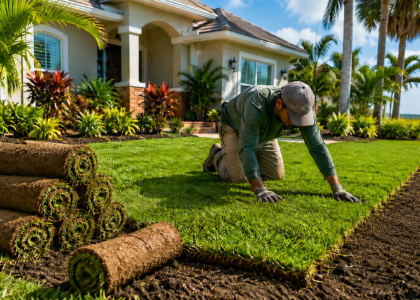
- New sod
- A paver patio
- A walkway
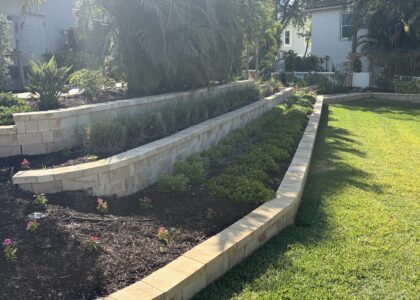
- A retaining wall
- A fence
- A pool deck update
- New landscape edging
- Expanded mulch areas
A raised bed may redirect runoff. A patio may increase the amount of surface water moving toward the lawn. Soil placed along a fence line may block a previous drainage route.
If standing water began after a property update, review how that change affected the grade and water flow.
Drainage should be considered before major landscape improvements are installed whenever possible.
Know When a Sump Pump May Be Considered
Some yards lack enough slope for gravity to move water toward the front of the property.
In these cases, a sump pump system may be considered. The pump pushes water through underground piping toward a selected discharge point.
A pump system requires planning around:
- The amount of water
- The pipe route
- The height difference
- Available power
- The pumping distance
- The outlet location
- Access for future inspection
Sump pumps are generally used for more difficult drainage conditions. They should not be treated as the first choice without evaluating whether grading or gravity drainage is possible.
Prepare Before Installing Sod or Plants
New sod and plants should not be installed over unresolved wet areas.
Before landscape restoration begins, review:
- Soil moisture
- Property grade
- Drainage routes
- Irrigation coverage
- Downspout locations
- The planned plant layout
New sod may continue struggling if the ground remains saturated. Plants installed in a wet bed may also require different conditions than the site provides.
Drainage and irrigation work should generally be completed before finished sod, plants, or mulch are installed.
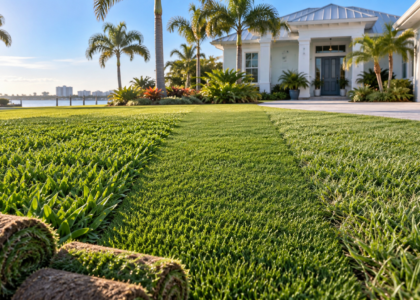
CDS Landscaping sod projects require at least 1,000 square feet and have a $1,500 labor minimum.
Understand the Drainage Installation Process
A professional drainage project generally begins with an evaluation of the full property.
The team reviews water sources, low areas, grade, hardscape, downspouts, irrigation, and possible outlets.
Installation may then include:
- Planning the pipe route
- Excavating trenches
- Installing catch basins
- Connecting downspouts
- Laying solid or perforated pipe
- Installing emitters
- Adding drainage rock where needed
- Backfilling the trenches
- Leveling disturbed areas
- Removing excess dirt and debris
The system should be based on the type of water problem rather than using the same solution for every property.
How Much Does Drainage Installation Cost?
Drainage pricing depends on the system, amount of pipe, excavation, site access, soil conditions, and discharge location.
CDS Landscaping bases most drainage pricing on the linear footage of pipe installed.
Drainage projects have a 50-foot minimum and a $1,800 minimum labor charge.
An onsite evaluation is needed to determine the full pipe route and final price.
Prepare Your Yard for Wet Weather
Heavy rain can expose problems involving roof runoff, low grading, blocked drains, saturated soil, pool decks, patios, and irrigation.
Preparing the property begins with watching where the water comes from and how it moves. The correct solution may involve cleaning an existing drain, adjusting irrigation, correcting the grade, connecting downspouts, installing catch basins, adding underground piping, or using another drainage system.
CDS Landscaping provides heavy rain drainage solutions in St. Petersburg, Seminole, Largo, Pinellas Park, Clearwater, and surrounding areas.
Contact CDS Landscaping to schedule a property evaluation if standing water or overflowing drains continue to appear after heavy rain.